English
 Arabic
 French
 Spanish
 Portuguese
 Deutsch
 Turkish
 Dutch
Dutch
 Italiano
 Russian
 Romaian
 Portuguese (Brazil)
 Greek
Greek
Pediatric Electronic Medical Records (EMR) Software Market Trends Report: Size, Segments, Growth & Forecast Overview
Other |
2026-06-01 12:18:02
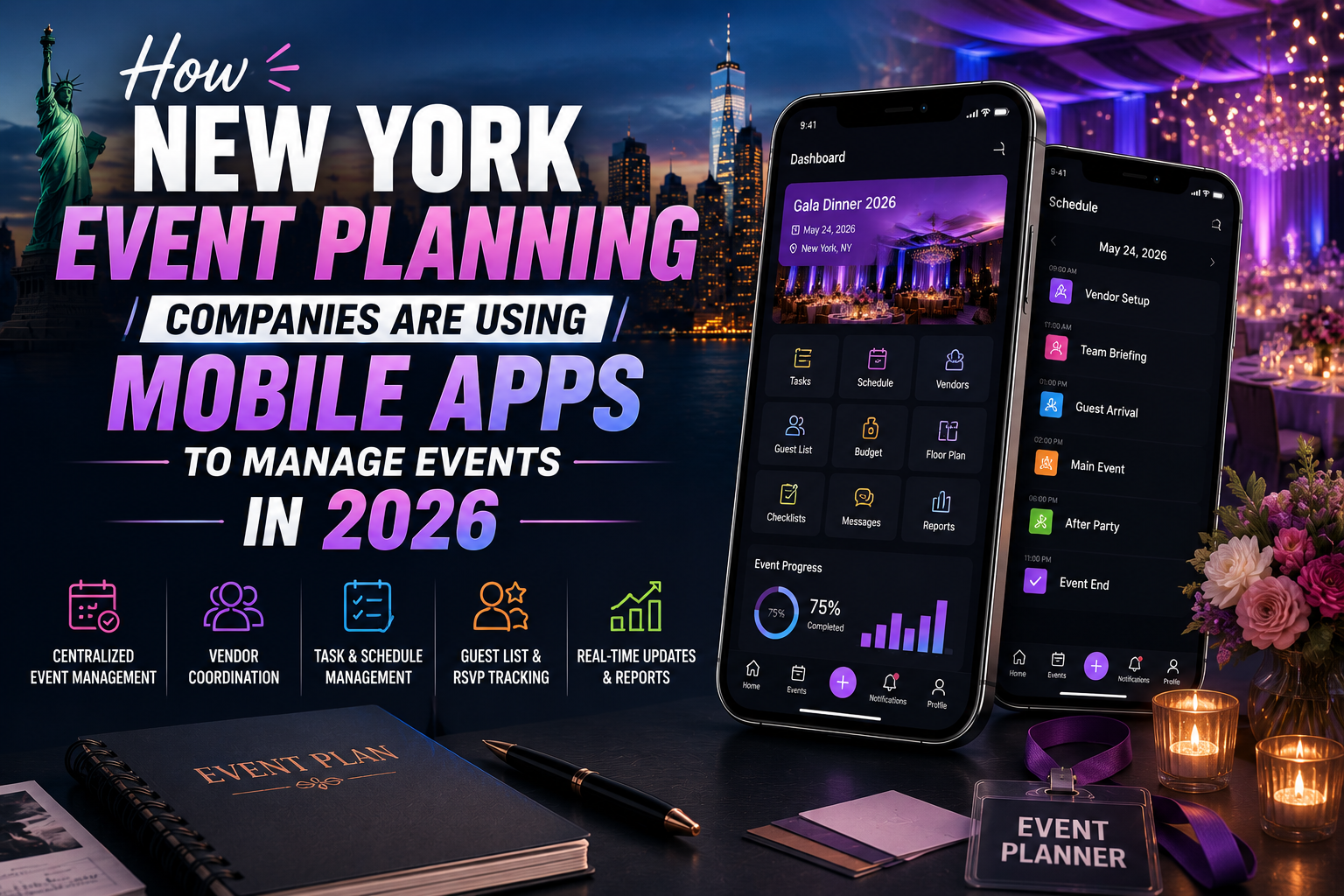
New York's event planning industry operates at a level of complexity that few other cities demand. A single wedding at a Manhattan venue might involve a dozen vendors, a caterer, a florist, a photographer, a band, a lighting designer, a transportation coordinator, a rentals company, all needing to arrive at precise times, execute their specific role, and coordinate seamlessly with everyone else. A corporate gala for 400 attendees requires guest list management, seating coordination, check-in logistics, and real-time problem-solving when something inevitably goes sideways.
For years, event planners managed this complexity through spreadsheets, group texts, walkie-talkies, and an almost superhuman ability to keep dozens of moving pieces in their heads simultaneously.
In 2026, the New York event planning companies scaling their business beyond what a founder can personally manage are doing it with custom mobile apps, purpose-built tools that coordinate vendors, manage guest experiences, and give clients visibility into their event's progress in ways that generic project management software was never designed to do.
Here's exactly how NYC event planning companies are using mobile apps to run more events, more profitably, with fewer last-minute crises.
Most event planning companies start with a patchwork of generic tools, Google Sheets for budgets, group texts for day-of coordination, email for client communication, and maybe a project management tool like Asana or Trello for internal task tracking.
This works at a small scale. It breaks down as the business grows.
Eventbrite's 2025 Event Industry Report found that event professionals spend an average of 12 hours per event on coordination tasks that could be automated or streamlined through purpose-built technology, vendor confirmations, timeline distribution, guest communication, and day-of logistics tracking.
The Special Events industry survey (2025) found that 68% of event planning companies reported at least one significant day-of-event miscommunication issue in the past year, vendors arriving at the wrong time, conflicting setup instructions, or guest list discrepancies, almost universally traced back to information living in disconnected tools rather than a single source of truth.
A custom mobile app solves this by giving every stakeholder, planner, vendor, client, and on-site staff access to the same real-time information, eliminating the gaps where miscommunication happens.
The most immediate value a mobile app delivers to an event planning business is vendor coordination.
Instead of separate email threads, group texts, and phone calls with each vendor, a custom app gives every vendor access to a shared event timeline, their specific arrival time, setup requirements, point of contact, and any last-minute changes, all updated in real time.
When a timeline shifts (the ceremony runs 20 minutes late, the load-in time changes due to a venue conflict), every vendor receives an automatic push notification with the update. No more calling six vendors individually to communicate a schedule change.
The operational impact: Event planning companies using app-based vendor coordination report significant reductions in day-of-event miscommunication incidents and meaningfully faster response times when last-minute adjustments are needed, because every vendor is working from the same real-time information instead of whatever version of the timeline they last received.
For clients planning a wedding, corporate event, or milestone celebration, the planning process can feel opaque and anxiety-inducing, especially in the final weeks before the event.
A client-facing portal within the app gives clients real-time visibility into their event's planning progress: confirmed vendors, finalized timeline, budget tracking against their original estimate, and a shared document library for contracts, floor plans, and design mockups.
This transparency reduces the volume of "checking in" calls and emails that consume planner time, while simultaneously increasing client confidence and satisfaction. Clients who can see exactly where their event stands, without having to ask, report significantly higher satisfaction with the planning process, independent of the event outcome itself.
For larger events, galas, conferences, and milestone celebrations with 100+ guests, managing the guest list, RSVPs, dietary restrictions, seating assignments, and day-of check-in is a substantial logistical undertaking.
A custom event app handles this end-to-end:
For corporate clients running conferences or galas, this functionality also generates valuable post-event data, attendance rates, no-show patterns, and guest demographics that inform future event planning.
The single most stressful period in any event is the day itself, when dozens of tasks need to happen in precise sequence, executed by different people, with no room for the kind of miscommunication that a busy phone line or missed text creates.
A mobile app with day-of task management assigns specific tasks to specific team members and vendors, with timestamps, dependencies, and completion confirmation. The lead planner has a real-time dashboard showing exactly what's been completed and what's pending — without needing to physically check on every vendor or walk the venue floor repeatedly.
When a task is marked complete (centerpieces placed, AV check completed, bar fully stocked), the next dependent task automatically notifies the responsible party. This sequencing eliminates the gaps where one delayed task cascades into a chaotic timeline.
The event isn't truly finished until feedback is collected and the relationship is positioned for future business, referrals, repeat corporate clients, or vendor partnership renewals.
An app-based post-event feedback flow automatically prompts clients for a review and testimonial within 24–48 hours of the event, while the experience is still fresh. This timing dramatically increases response rates compared to a follow-up email sent a week later.
For event planning companies building a portfolio of past work, the app can also automatically prompt for permission to use event photos in marketing materials, streamlining a process that's often handled inconsistently through ad hoc email requests.
| App Type | Features | Estimated Cost | Timeline |
|---|---|---|---|
| Basic Coordination App | Vendor timeline sharing, push notifications | $18,000 – $35,000 | 10–14 weeks |
| Mid-Tier Platform | Above + client portal + guest RSVP management | $35,000 – $75,000 | 14–22 weeks |
| Full Event Management Platform | Above + day-of task management + check-in + feedback automation | $75,000 – $150,000 | 22–32 weeks |
Post-launch monthly costs:
For an event planning company managing 60 events per year at an average management fee of $12,000:
Capacity increase from coordination efficiency (handling 15% more events annually with the same team, due to reduced administrative overhead): 9 additional events × $12,000 = $108,000/year
Reduced day-of crisis management (fewer emergency vendor calls, reduced overtime for planning staff fixing miscommunication issues): Estimated $15,000/year in reduced labor costs
Improved client referral rate (from better experience and faster feedback collection, 10% increase in referral-driven new business): 6 additional referred events × $12,000 = $72,000/year
Total estimated annual upside: $195,000
Against a $55,000 app investment, the payback period is approximately 3–4 months.
When evaluating a software development company in New York for your event planning business, look for:
Q1. Should we build a custom app or use existing event management software like Aisle Planner or HoneyBook?
Existing platforms offer faster setup and lower upfront cost, and they're a reasonable starting point for smaller operations. A custom app becomes the right investment when you've outgrown the platform's limitations, want a fully branded client and vendor experience, or need specific workflow features that generic platforms don't support well, particularly for companies managing high event volume or complex multi-vendor coordination.
Q2. How do we get vendors who work with multiple planning companies to actually use our app?
Make the app genuinely easier than the alternative, and most vendors will adopt a tool that saves them time over phone calls and email chains. Keep the vendor-facing interface simple: they need their timeline, their tasks, and a way to flag issues. Avoid requiring vendors to learn a complex system; the value should be immediately obvious from their first use.
Q3. Can the app handle multiple simultaneous events?
Yes, a properly architected event management app handles multiple concurrent events with separate timelines, vendor lists, and client portals, while giving your internal team a unified dashboard view across all active events. This is essential functionality for any planning company managing more than a handful of events per month.
Q4. How does the app handle last-minute changes during a live event?
This is one of the most valuable real-time functions. Authorized team members can update the timeline or task assignments directly from their phone during the event, and affected vendors and staff receive immediate push notifications. This real-time adjustment capability is often cited as the single most valuable feature during actual event execution.
Q5. Is this investment worth it for a smaller event planning company?
The investment makes the most sense once you're managing 25+ events per year or have a team beyond the founder coordinating events. Below that volume, the operational complexity may not yet justify a full custom build, though even smaller companies benefit from app-based client portals for differentiation and improved client experience.
New York's event planning industry runs on flawless execution under pressure, and flawless execution depends on every stakeholder having the right information at the right moment. Spreadsheets, group texts, and phone calls were never built to deliver that level of coordination reliably at scale.
A custom mobile app gives event planning companies the infrastructure to manage more events, with fewer crises, and a client experience that builds the kind of referral-generating reputation that grows a business in New York's competitive events market.
Work with a software development company in New York that understands multi-stakeholder coordination, builds for real-time reliability, and delivers a product that performs flawlessly when it matters most, during the live event itself.
Because in event planning, there are no second chances. The technology supporting your team needs to be as reliable as your team itself.