English
 Arabic
 French
 Spanish
 Portuguese
 Deutsch
 Turkish
 Dutch
Dutch
 Italiano
 Russian
 Romaian
 Portuguese (Brazil)
 Greek
Greek
Japan Antimicrobial Plastic Market Size, Growth Report 2035
Other |
2026-06-01 09:01:21
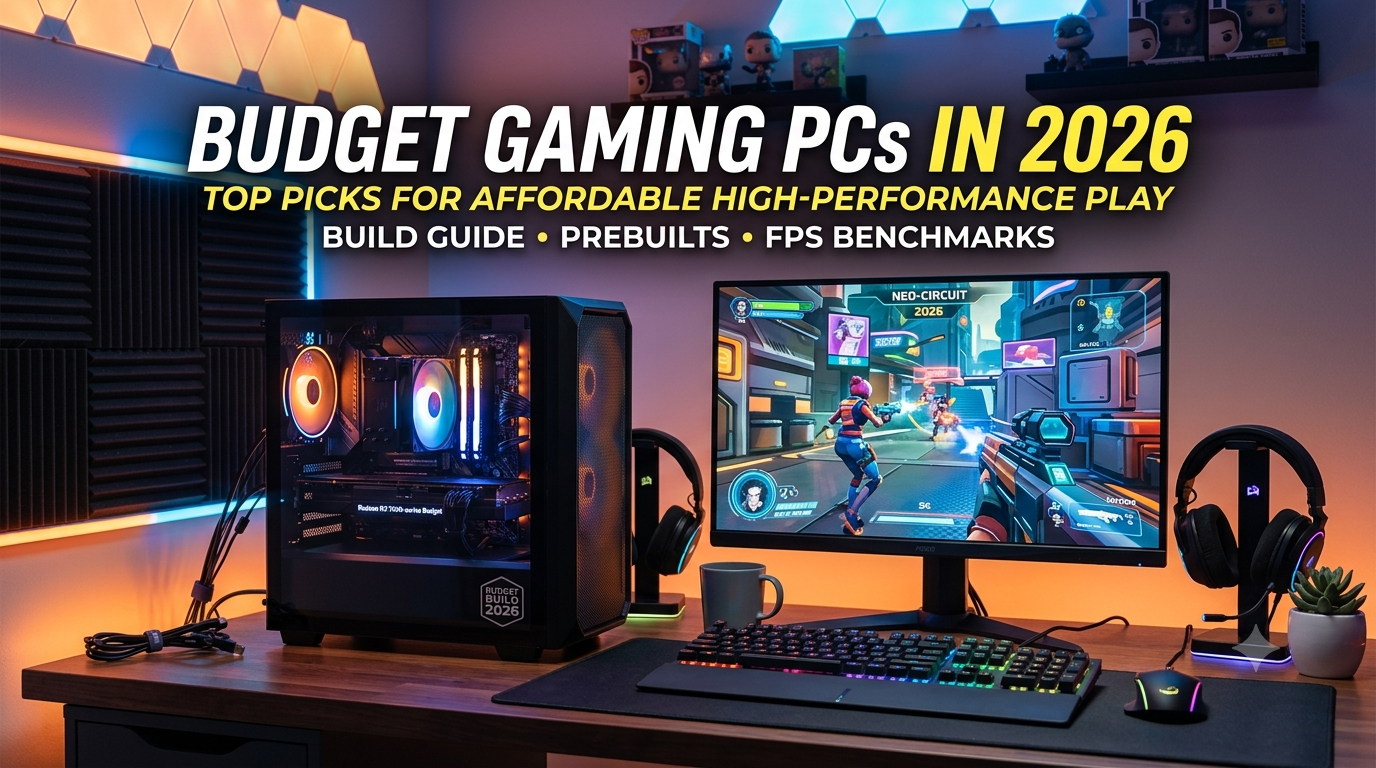
For years, the phrase budget gaming PC meant one thing—getting the best possible gaming experience without spending a fortune. A ₹60,000 PC could comfortably handle the latest AAA titles at respectable settings, while enthusiasts debated whether AMD or Intel offered the better value.
That conversation has changed.
In 2026, building a budget gaming PC is no longer just about choosing affordable components. It's about navigating rising hardware prices, increasingly demanding games, and a market where "entry-level" hardware often carries mid-range price tags.
The definition of a budget gaming PC has quietly evolved.
The End of the ₹50,000 Gaming PC?
A few years ago, a ₹50,000–₹60,000 gaming PC was a realistic recommendation for most gamers. Today, that same budget often requires compromises.
Modern games are larger, more graphically intensive, and increasingly optimized for technologies like ray tracing, AI upscaling, and high-speed SSDs. Meanwhile, newer processors and graphics cards deliver significant performance gains—but at higher launch prices.
The result is simple: expectations have grown faster than budgets.
Buying the cheapest components available no longer guarantees a satisfying gaming experience.

Performance Per Rupee Matters More Than Price
Many buyers still search for the lowest-priced gaming PC, but experienced builders know that value isn't measured by the invoice alone.
A system with an underpowered graphics card, slow memory, or an entry-level power supply may save money today but could require major upgrades within a year.
Instead, the smarter investment is a balanced configuration where every component complements the others.
A well-matched CPU and GPU, fast DDR5 memory, a reliable motherboard, and a quality power supply often outperform cheaper systems that appear similar on paper.
The Rise of AI in Gaming
Another factor reshaping the budget segment is AI.
Technologies such as frame generation, AI upscaling, and intelligent rendering have become standard features in modern gaming. These innovations allow gamers to achieve higher frame rates without relying solely on raw GPU power.
As game developers continue adopting AI-assisted rendering, choosing hardware that supports these technologies becomes increasingly important—even for budget systems.
A gaming PC purchased today should be ready for tomorrow's games, not just today's benchmarks.
Why Pre-Built Doesn't Mean Compromise Anymore
There was a time when enthusiasts believed building a PC yourself was the only way to maximize value.
Today, that assumption doesn't always hold true.
Professional system integrators can source compatible components, perform thermal validation, optimize BIOS settings, stress-test the entire system, and provide comprehensive warranty support.
For many gamers, especially first-time buyers, a professionally assembled gaming PC offers better long-term reliability than assembling parts without experience.
The focus has shifted from who built the PC to how well it was engineered.
The Hidden Cost of Cheap Components
Budget doesn't mean cutting corners.
Inferior power supplies, poor airflow, inadequate cooling, and low-quality storage are often invisible during purchase but become painfully obvious after months of gaming.
Random crashes, thermal throttling, excessive noise, and shortened component lifespan usually originate from these overlooked parts—not the CPU or graphics card.
Experienced PC builders understand that reliability is part of performance.
So, What Should Gamers Buy in 2026?
Rather than chasing the lowest possible price, buyers should look for systems that deliver the best long-term value.
A good budget gaming PC should offer:
These choices ensure the system remains relevant for years instead of months.
ANT PC's Perspective
At ANT PC, we believe a budget gaming PC should never feel like a compromise.
Our engineering philosophy prioritizes component compatibility, thermal efficiency, stability, and upgradeability. Every gaming PC is assembled, stress-tested, and optimized to deliver consistent performance across modern AAA games, esports titles, and content creation workloads.
Rather than chasing the lowest price, we focus on building systems that offer the highest value over their lifetime—because a gaming PC should remain an investment, not become an upgrade project after a few months.
Final Thoughts
The gaming hardware market has matured. Components are more powerful than ever, but they're also more expensive. As a result, the definition of a budget gaming PC has shifted from finding the cheapest machine to making the smartest purchase.
In today's market, informed component selection, system balance, and build quality matter just as much as the price tag.
The best budget gaming PC isn't necessarily the least expensive one—it's the one that continues to deliver reliable gaming performance long after the excitement of the purchase has faded.
Originally Published at https://groups.google.com/g/ant-pc-workplace/c/JrQDY8KsGa4